NONCOMPACTION (NCCM)
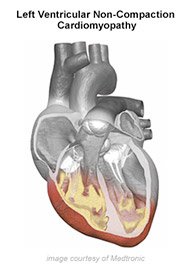
Noncompaction cardiomyopathy (NCCM) is a relatively new subtype being recognized in children. Also known as left ventricular noncompaction cardiomyopathy (LVNC), isolated ventricular noncompaction cardiomyopathy, and spongiform cardiomyopathy, it is a rare form of cardiomyopathy.
With NCCM, the heart muscle appears to have a spongy or noncompacted appearance. Because the heart has failed to transform from spongy muscle fibers to compacted solid muscle during fetal development, deep grooves (trabecular recesses or trabeculations) appear in the heart muscle wall of the main pumping chamber (left ventricle). Noncompaction can present with normal heart function or with heart dysfunction where the heart muscle does not squeeze normally and there is poor contraction and/or poor filling of the heart.
When NCCM occurs with normal left ventricular thickness, size and function, it is called isolated ventricular noncompaction cardiomyopathy. NCCM can occur in combination with abnormalities in heart squeeze (dilated form of NCCM) or in heart relaxation (hypertrophic or restrictive form of NCCM). Noncompaction may also involve the right lower chamber of the heart (right ventricle). The course of the disease and outcomes will depend on the NCCM subtype and prescribed treatment.
It is unknown what causes the disruption in heart development to cause noncompaction. NCCM has been classified as genetic in origin and several genes linked to other forms of cardiomyopathy are thought to be associated with this condition.